
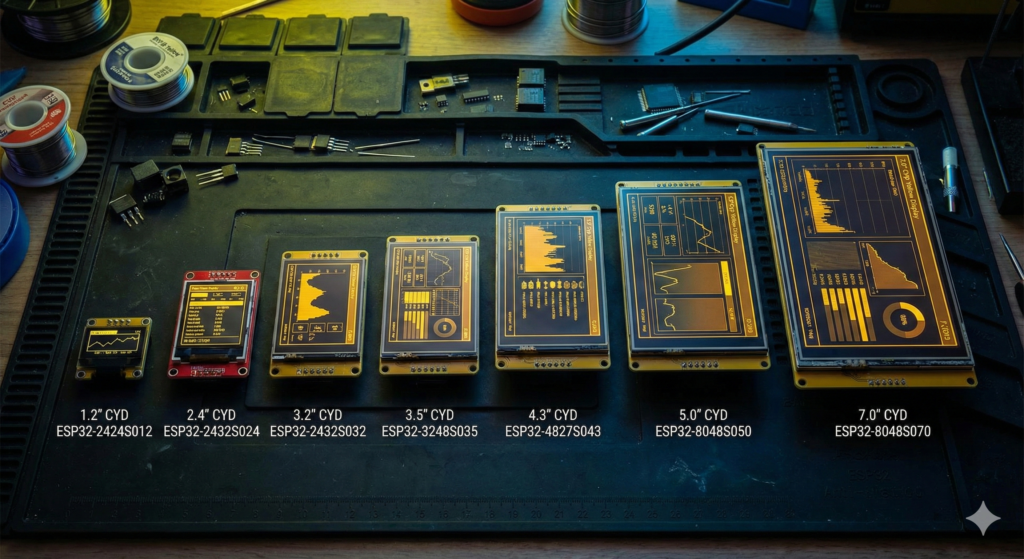
Let us talk about ESP32-2432S028R (and similar) development board, colloquially identified within the hardware development community as the “ESP32 Cheap Yellow Display” (CYD). This module provides a sophisticated, fully integrated hardware canvas for a fraction of the cost of similar embedded systems (think of Pi4+Display at $200+). At a procurement cost of less than $15, the CYD effectively becomes undisputed champion of budget graphical user interfaces (GUIs), Internet of Things (IoT) edge computing, and complex telemetry visualization.
The CYD Silicon Matrix
Because buying a “Cheap Yellow Display” is a lottery. Know exactly what hardware you are dealing with.
The CYD is engineered around the venerable ESP32-WROOM-32 module, a dual-core microcontroller that natively integrates Wi-Fi 4 and Bluetooth 4.2. It excels in real-time processing environments where full-scale operating systems, such as Linux on a Raspberry Pi, would introduce unacceptable scheduling latency and excessive power overhead.
Here are the Top 5 ESP32 Cheap Yellow Display Projects you need to compile this weekend.
Table of Contents
1. The Portable Marauder Cybersecurity Rig
Network security testing, spectrum analysis, and penetration auditing traditionally require cumbersome, highly expensive proprietary equipment. The porting of the ESP32-Marauder firmware to the ESP32 Cheap Yellow Display democratizes wireless auditing, transforming a $15 board into an immensely capable, standalone cybersecurity testing rig.
The Marauder firmware executes a rigorous suite of diagnostic tools. It performs advanced Access Point (AP) scanning that integrates deep security protocol verification, Wi-Fi Protected Setup (WPS) vulnerability checks, and precise hardware manufacturer identification based on MAC Organizationally Unique Identifiers (OUIs). The interface includes dedicated Wi-Fi and BLE analyzers that generate real-time channel graphs, allowing you to visually identify spectrum congestion instantly.
For packet-level forensics, the rig supports Raw Capture functionality, intercepting raw 802.11 frames and writing the output directly to a FAT32-formatted MicroSD card in PCAP format. It is equally formidable in Bluetooth diagnostics, featuring specialized code to detect, sniff, and spoof Apple AirTags, providing a mechanism to audit local physical tracking vulnerabilities.
If you want to do comprehensive wardriving-mapping wireless networks to exact geolocation coordinates, you can integrate an external GPS module like the ATGM336H NEO-6M directly to the CYD via the 4-pin UART connector.
With regular updates and CYM Web Flasher, The ESP32-Marauder-Cheap-Yellow-Display is for sure a try worthy project.
Fr4nkFletcher / ESP32-Marauder-Cheap-Yellow-Display
The aim of this project is to port the ESP32-Marauder firmware to the Cheap Yellow Display (CYD), offering powerful WiFi and Bluetooth testing features on an affordable and accessible hardware platform.
2. High-Fidelity Automotive CAN Bus Telemetry
Commercial automotive diagnostic gauges are frequently encumbered by exorbitant proprietary pricing and locked, inflexible software ecosystems. The ESP32 Cheap Yellow Display Bluetooth OBD2 Gauge project fundamentally subverts this dynamic, utilizing the CYD hardware to render a highly customizable, real-time vehicle telemetry dashboard.
The architectural foundation relies heavily on an ELM327 Bluetooth adapter, which interfaces directly with your vehicle’s On-Board Diagnostics (OBD2) port. Pay attention to this: you must strictly source ELM327 adapters utilizing version 1.5 firmware. The widely available version 2.1 adapters are plagued with severe protocol communication regressions and failing AT command parsing, rendering them fundamentally incapable of sustaining the high-speed data stream required by the ESP32.
Once a reliable Bluetooth Classic connection is negotiated, the firmware continuously polls the vehicle’s Engine Control Unit (ECU) for specific Parameter IDs (PIDs). It pulls Engine Load, Coolant Temperature, Manifold Air Pressure (MAP), and real-time tachometer data.
Because automotive cabin environments are incredibly hostile to consumer-grade electronics, enduring extreme thermal fluctuations, the firmware incorporates a CPU overheat protection algorithm. This routine continuously polls the ESP32’s internal thermal sensor, aggressively throttling clock speeds or forcing a thermal shutdown if junction temperatures approach critical limits.
VaAndCob / ESP32-Blutooth-OBD2-Gauge
An open-source digital dashboard for your vehicle. Bridges high-speed automotive CAN bus telemetry from an ELM327 Bluetooth adapter directly to the ESP32, featuring dynamic graphical gauges and thermal CPU protection.
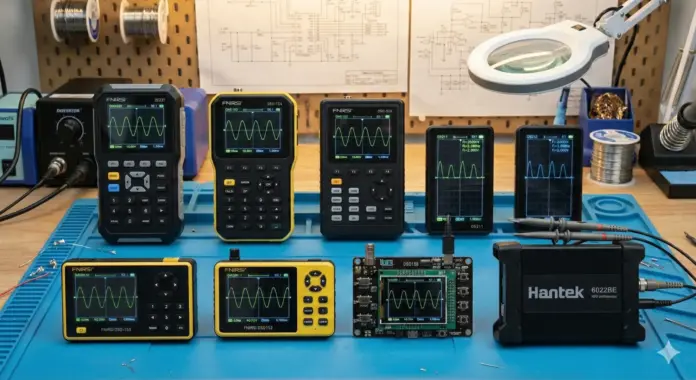
3. High-Frequency Analog Signal Analysis (Portable Oscilloscope)
Oscilloscopes are non-negotiable instruments for any serious electronics laboratory, yet entry-level commercial units consistently present a massive financial barrier, retailing anywhere between $500 and $2,000. The ESP32 Cheap Yellow Display Portable Oscilloscope project violently disrupts this market dynamic by directly mapping the input of high-frequency analog signals to the CYD’s display, creating an ultra-compact testing apparatus for roughly the cost of a cup of coffee.
Engineering a functional oscilloscope atop a $15 microcontroller presents immense computational challenges. The ESP32’s internal Analog-to-Digital Converters (ADCs) suffer from a well-documented lack of linearity and severe electrical noise.
To bypass the severe processor overhead generated by initiating individual, sequential analogRead() commands, this project relies heavily on Direct Memory Access (DMA) protocols. By configuring the ESP32’s ADC to write incoming voltage data directly into a massive 50,000-sample array residing in RAM, it entirely bypasses the dual-core CPU.
The theoretical maximum sampling rate of the ESP32’s ADC utilizing DMA is nominally 2 Megasamples per second (Msps). However, when the Wi-Fi transceiver is active, localized electromagnetic interference and shared internal silicon architecture heavily throttle the ADC capability down to a mere 1,000 samples per second. To achieve the targeted 1 Msps rate required by this project to accurately visualize audio waveforms and fast PWM signals, the Wi-Fi and Bluetooth logic must be aggressively shut down at the firmware level.
Crucially, to overcome the ESP32’s 0.21V hardware dead-zone, you must inject a micro-voltage supplement of approximately 0.07V directly into the ADC pin. This tiny voltage bias artificially elevates the baseline signal just above the ESP32’s hardware threshold, ensuring signals dropping near absolute ground are accurately digitized.
ivan-rio / ESP32-Oscilloscope
A bare-metal approach to high-frequency analog signal analysis. Utilizes Direct Memory Access (DMA) to achieve 1 Msps sampling rates on a single channel, rendering complex waveforms and PWM signals without CPU bottlenecking.
4. The Intelligent, Off-Grid ESPHome Dashboard
If you self-host, you likely share my profound disdain for home automation deployments reliant on cloud-tethered, proprietary hubs that suffer from internet outages and data privacy concerns. The integration of the ESPHome framework with the Cheap Yellow Display offers a completely localized, highly responsive smart home dashboard that feeds telemetry directly into Home Assistant.
Setting up the ESP32 Cheap Yellow Display within the ESPHome ecosystem brilliantly circumvents the requirement to write and compile thousands of lines of complex C++ display driver code. Instead, the firmware payload is generated dynamically through highly readable, declarative YAML structures.
I’m currently building a custom steel and wood rack for my Luminous Solarverter PRO 2KVA ECO and twin 150Ah batteries, and tracking off-grid solar telemetry without messy wiring is vital. For off-grid operation, the physics of sustaining an ESP32 dictates exact mathematical energy budgeting. Running continuously, the board requires a minimum baseline of 13.8 Watt-hours (Wh) per day.
To sustain this profile autonomously, pair a mini monocrystalline solar panel with an 18650-form-factor LiFePO4 battery. LiFePO4 chemistry is favored because its nominal voltage rests at 3.2V, which perfectly aligns with the absolute maximum voltage tolerances of the ESP32 silicon. This allows you to connect the battery directly to the ESP32’s 3.3V rail, completely bypassing inefficient Low-Dropout (LDO) linear regulators and eradicating parasitic thermal energy losses.
By programmatically transitioning from Active Mode to Deep Sleep, power consumption collapses from over 100mA down to a microscopic 10µA to 150µA range. The ESPHome YAML can be engineered so the dashboard remains in this ultra-low-power state, waking instantaneously upon a physical hardware interrupt registered by the touch controller.
esphome / esphome
A system that lets you control your ESP boards through simple yet powerful configuration files. Integrates the Light and Versatile Graphics Library (LVGL) to render gorgeous, touch-interactive smart home widgets locally, pushing MQTT payloads seamlessly to Home Assistant.
5. 3D Printer Command Centre/s
The default physical interfaces attached to many commercial and open-source 3D printers are severely lacking (damn you P1S), frequently relying on archaic monochrome text displays navigated via clunky, unresponsive rotary encoders. When I’m prototyping functional prints-like the custom brackets for the street dog feeders I set up around the colony-I don’t have the patience to scroll through endless nested menus. The ESP32 Cheap Yellow Display entirely resolves this bottleneck by acting as a dedicated, high-resolution command and control centre.
Two dominant open-source projects govern this space: xTouch (specifically engineered to hijack telemetry from BambuLab proprietary systems) and CYD-Klipper (targeting the massive open-source Klipper printer ecosystem).
The xTouch firmware is designed to intercept and parse the API telemetry emitted by BambuLab machines (like the P1P and P1S), providing a top-tier touch experience. You can physically wire an external DS18B20 digital 1-Wire temperature sensor directly into the CYD’s auxiliary connector to track heated chamber temperatures – a metric base-model Bambu Labs completely lack.
For engineers embedded deep within the Klipper universe, CYD-Klipper offers unparalleled, low-level machine control. It interfaces wirelessly with the Moonraker endpoint, pulling dense JSON payloads containing advanced print statistics and specific hardware logic states. CYD-Klipper shines brightest in its ability to execute predefined, complex G-code macros and manage microscopic Z-offset calibrations mid-print.
xperiments-in / xtouch
Dedicated high-resolution command interface designed to hijack BambuLab API telemetry. Provides full capacitive touch control over P1P/P1S printers and supports external DS18B20 chamber thermistors.
suchmememanyskill / CYD-Klipper
Interfaces wirelessly via the Moonraker API to execute complex G-code macros, dynamic Z-offsets, and heavy telemetry extraction for Klipper-based hosts.
Add your favourite project below and we might consider it in our next ESP32 Cheap Yellow Display Projects shootout!
Thanks