
Your multimeter is only telling you half the story. To see what is actually happening in your circuit, a Digital Storage Oscilloscope (DSO) is not a luxury – it is an absolute necessity. You no longer need to settle for ancient, uncalibrated analog hardware to get the job done. In this guide, we cut through the noise to find the Best Oscilloscopes in India Under ₹10K that delivers real engineering value for your hard-earned money.
Table of Contents
Advanced Hardware Debugging: Why a Multimeter is Inadequate
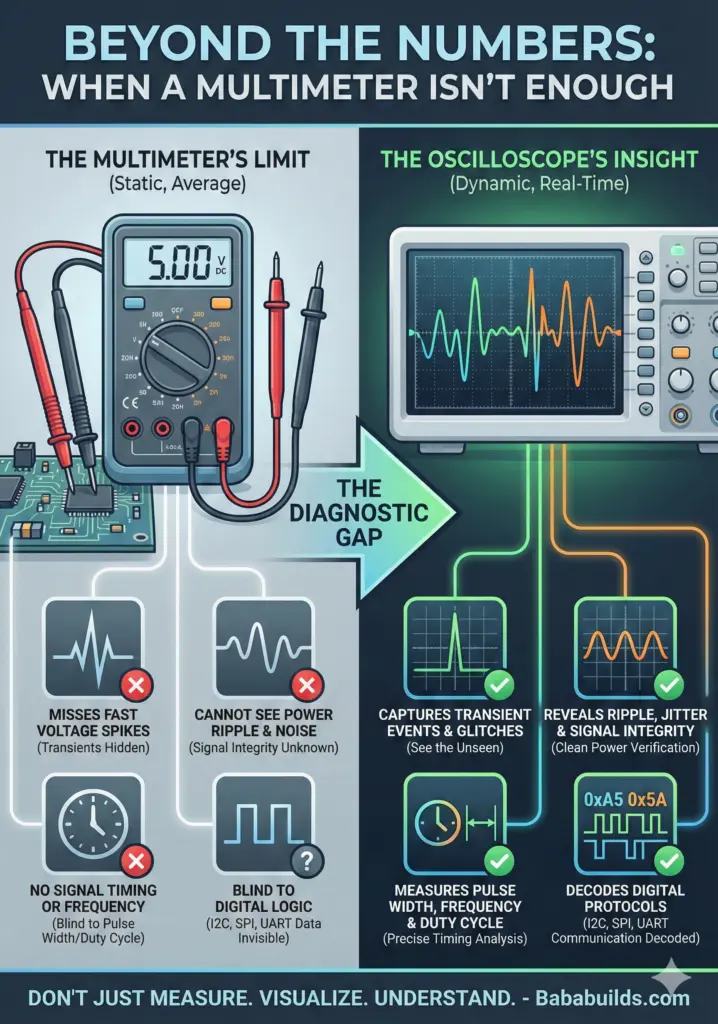
Before examining the top nine oscilloscopes, understanding the specific scenarios where these tools provide indispensable value is critical. A standard digital multimeter typically samples data a few times per second and displays the root-mean-square (RMS) or average DC voltage. This is entirely inadequate for diagnosing high-speed, dynamic, or noisy circuits.
Decoding Microcontroller Protocols (I2C, SPI, UART)
When a sensor refuses to talk to an ESP32, a multimeter will only tell you if the voltage is present. An oscilloscope lets you actually “see” the conversation. By hooking up probes to the SDA and SCL lines of an I2C bus, you can verify if the clock is pulsing correctly, if the data lines are pulling down to true ground, or if a missing pull-up resistor is turning your crisp digital squares into sluggish, curved waves.
Hunting Down Power Supply Ripple and Noise
Clean power is the backbone of any stable home lab. When you are consolidating multiple 5V and 12V adapters into a single, beefy central power supply (like a Mean Well LRS-200), an oscilloscope is mandatory. It allows you to check the DC voltage for high-frequency AC ripple or voltage spikes that can cause sudden reboots on sensitive repurposed server gear or corrupt data on your hard drives.
Analyzing PWM Signals
Pulse Width Modulation (PWM) is everywhere in DIY electronics. Whether you are checking the efficiency of a custom solar charge controller, tuning the stepper motor drivers on a 3D printer, or building a custom fan controller for a server rack, an oscilloscope allows you to measure the exact duty cycle and frequency of the PWM wave. This guarantees your hardware is switching exactly when it is supposed to, without dangerous voltage overshoot.
Catching Sensor Noise and Switch Bounce
Physical buttons and mechanical relays rarely open or close cleanly; they “bounce,” sending dozens of rapid-fire open/close signals in a few milliseconds. If a custom Home Assistant node is triggering multiple times from a single button press, an oscilloscope lets you capture that microsecond bounce. This helps you calculate exactly what size hardware capacitor you need to filter the noise, or how many milliseconds of software debounce to add to your code.
Diagnosing Dead Motherboards and Repurposed Hardware
When bringing old, dead hardware back to life—like trying to root and repurpose an old smartphone into a lightweight Linux server—an oscilloscope helps you verify if the board is actually dead. You can probe the crystal oscillators to see if the core clock is ticking, check if the flash memory is transmitting data during boot-up, and verify that the onboard VRMs are delivering stable core voltages to the CPU.
Buyer’s Guide: Best Oscilloscopes in India under 10K
When navigating the sub-10K price bracket for a cheap digital storage oscilloscope, manufacturers frequently inflate specifications or rely on aggressive marketing terminology that obscures the true operational capabilities of the hardware. Understanding the fundamental electronic principles and mathematical limitations behind these devices is critical for making an informed, value-driven purchasing decision.
Analog Bandwidth vs. Sample Rate: The Mathematics of Signal Capture
The two most prominent metrics on any oscilloscope datasheet are the analog bandwidth (measured in Megahertz, MHz) and the sample rate (measured in Mega-Samples per second, MSa/s). Understanding the relationship between these two figures is the difference between purchasing a useful diagnostic instrument and an educational toy.
Analog Bandwidth refers to the frequency at which the analog input signal is attenuated by -3 dB by the front-end amplifier circuitry. At this exact frequency, the displayed signal will be roughly 70.7% of its actual physical amplitude. However, attempting to measure a signal at the absolute limit of the oscilloscope’s rated bandwidth results in severe visual distortion.
For digital logic signals—such as SPI, I2C, or UART data lines—the waveform is never a pure, fundamental sine wave. Digital signals are square waves, and according to Fourier analysis, a square wave is composed of a fundamental frequency combined with an infinite series of higher-order odd harmonics. To accurately visualize a square wave with sharp, crisp rising and falling edges, the oscilloscope must possess a bandwidth at least five times higher than the fundamental frequency of the signal.
Sample Rate dictates how rapidly the oscilloscope’s Analog-to-Digital Converter (ADC) captures and digitizes discrete voltage data points every second. According to the foundational Nyquist-Shannon sampling theorem, the sample rate must be at an absolute minimum twice the highest frequency present in the incoming signal just to avoid aliasing (a phenomenon where the scope displays a completely false, low-frequency artifact).
In practical digital storage oscilloscope architecture, a sample rate of 5 to 10 times the stated analog bandwidth is required for accurate, high-fidelity signal reconstruction. A common, deceptive flaw in ultra-cheap budget oscilloscopes is pairing a 10 MHz or 20 MHz bandwidth with a critically low sample rate, resulting in severe digital interpolation artifacts and a complete inability to capture fast, unpredictable transient voltage spikes.
Standalone Scopes vs. PC-Based Scopes
The modern budget oscilloscope market is divided into two distinct architectural hardware categories: standalone units and tethered PC-based (USB) oscilloscopes. Each caters to a completely different diagnostic workflow.
Standalone Scopes (such as the majority of the FNIRSI lineup) are entirely self-contained embedded systems. They are equipped with their own TFT LCD screens, internal lithium-ion batteries, analog front-ends, and internal processing units (often built around generic ARM Cortex processors or low-cost Field Programmable Gate Arrays). These devices heavily prioritize portability, physical isolation from mains earth, and immediate ease of use. They are the ideal form factor for field diagnostics, checking automotive sensors inside an engine bay, and quick, spontaneous benchtop measurements where booting up a host computer is highly inconvenient.
PC-Based Scopes (such as the Hantek 6022BE) follow a radically different design philosophy. The physical hardware chassis contains only the analog front-end amplifiers, the ADC, and a USB streaming controller (often a Cypress FX2 microcontroller). These devices have no screen, no battery, and zero onboard analytical processing capability; they rely entirely on a high-speed USB connection to stream massive amounts of raw voltage data directly to a host computer. The computer’s CPU handles all the complex signal processing, display rendering, and deep data storage.
The Countdown: Top 9 Oscilloscopes in India Under 10K
The following analytical breakdown ranks the most viable budget oscilloscopes currently available in the Indian electronic market.
Rank 9: DS212 – The Open-Source Pocket Hacker
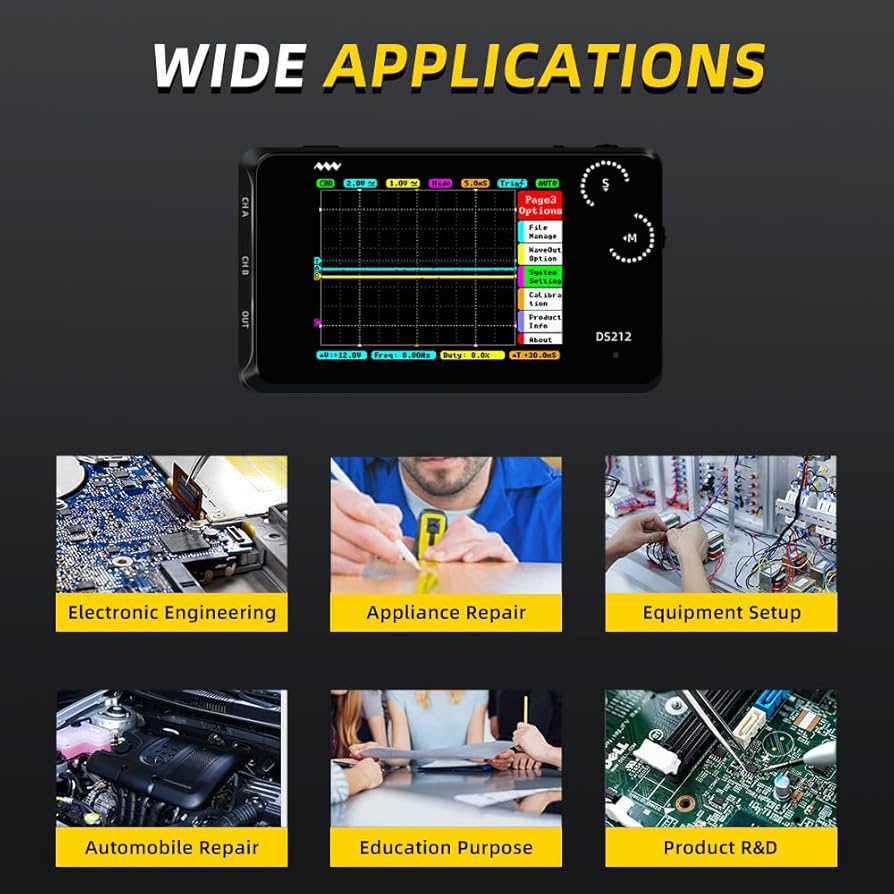
The DS212 is a highly compact, dual-channel pocket oscilloscope built inside a sleek, premium aluminium and glass chassis that strongly resembles the form factor of an early-generation smartphone. Powered by an internal rechargeable battery and an STM32 ARM microprocessor, this device is designed strictly for high portability and on-the-go hardware hacking. Its internal hardware features 8K of digital sample memory and a 10 Mega-samples per second front end. This provides just enough resolution to analyze slow audio frequency signals, basic 5V automotive sensors, or extremely low-speed serial data communication.
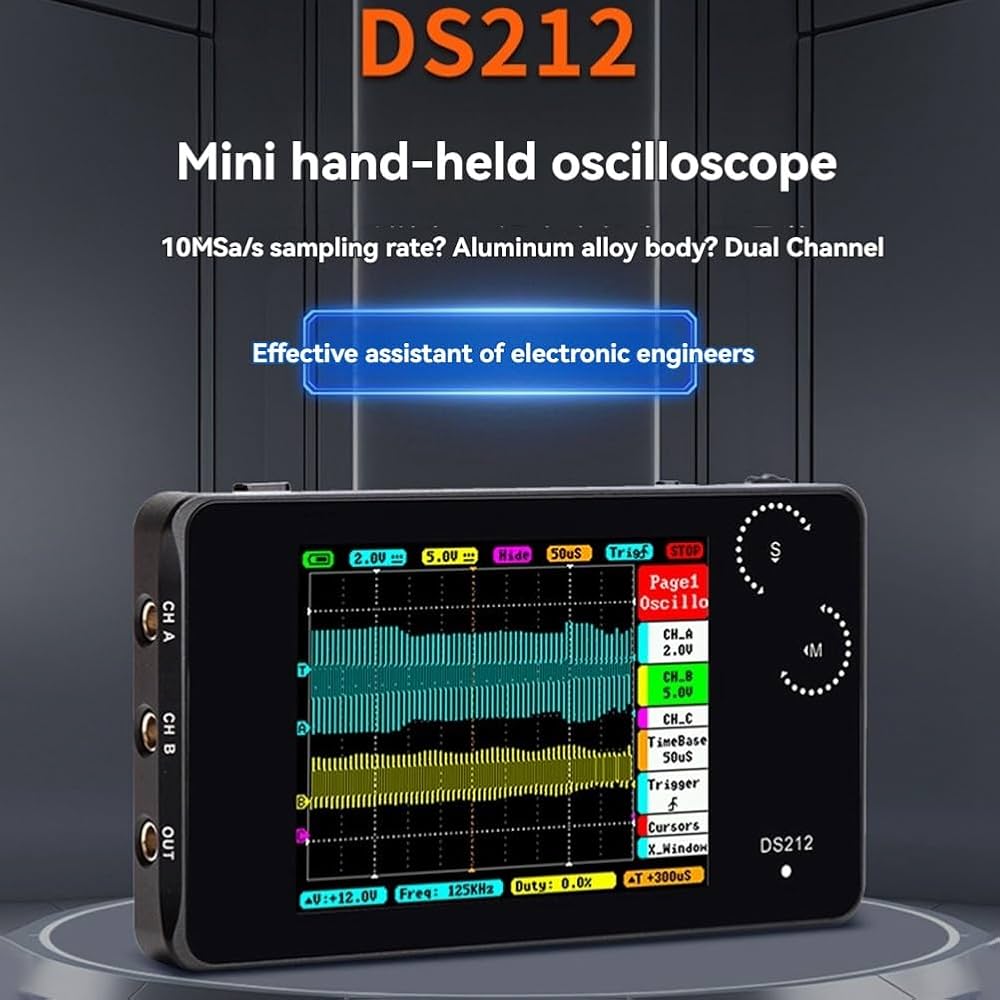
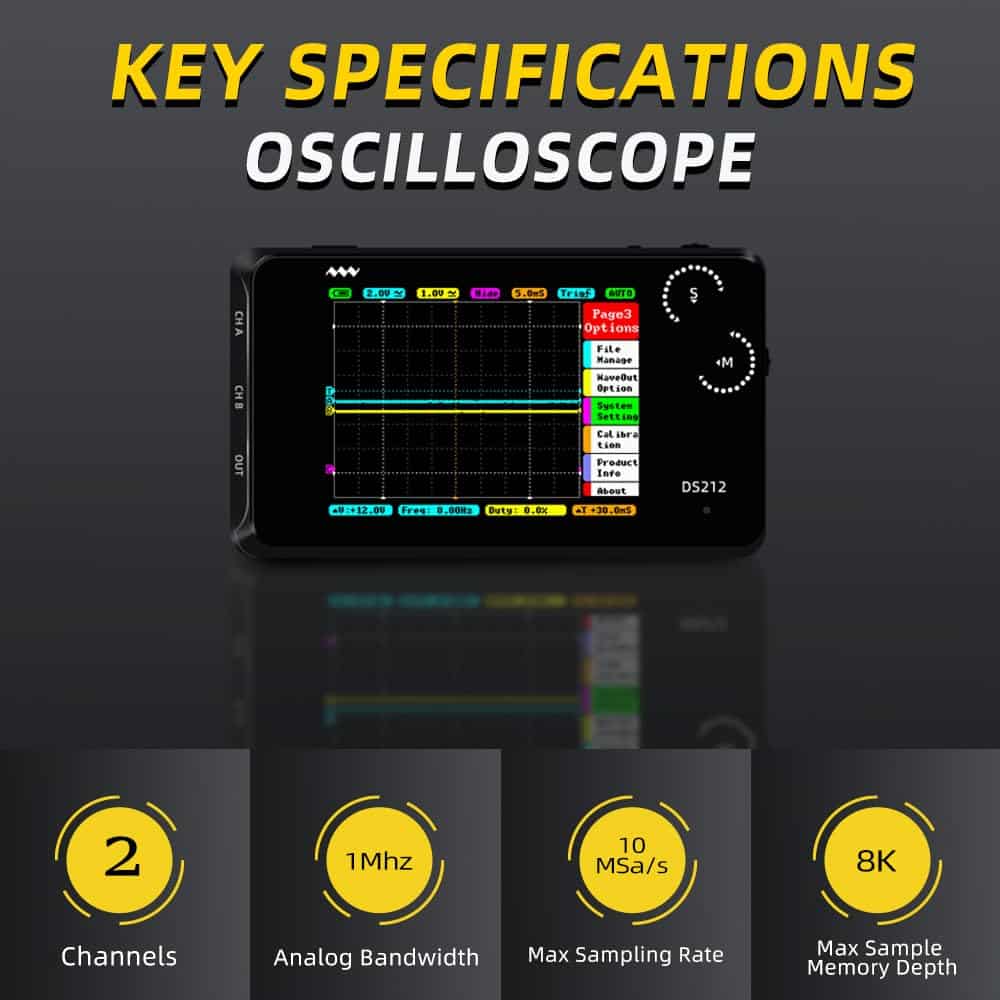
What sets the DS212 apart from the deluge of other budget devices is its firm commitment to an open-source architecture. The firmware running on the internal STM32 processor is fully open source, which has fostered a highly dedicated, niche community of developers who write and distribute custom software specifically for the device.
Advanced users can program the integrated signal generator to output highly custom, complex waveforms, effectively transforming the DS212 into a bespoke, self-contained troubleshooting platform for testing highly specific logic circuits. Physical navigation is handled via two mechanical rotary encoders rather than a modern touchscreen, providing tactile, precision feedback that many old-school engineers prefer when making minute time-base adjustments. It can even run entirely headless, acting as a data logger.
DS212
Our Review
The engineering behind the DS212 is undeniably impressive, and its premium build quality is rare in this segment. However, its price-to-performance ratio in the Indian market is severely lacking. Spending well over ₹10,000 for a mere 1 MHz of analog bandwidth is a highly difficult proposition to justify when desktop-class bandwidth can be acquired for significantly less capital. This specific device is strictly recommended only for hardcore open-source software enthusiasts who explicitly desire a highly hackable STM32 development platform that happens to fit in a shirt pocket, rather than an engineer seeking a primary, daily-driver diagnostic tool.
Rank 8: DS211 – The Stripped-Down Single Channel Variant
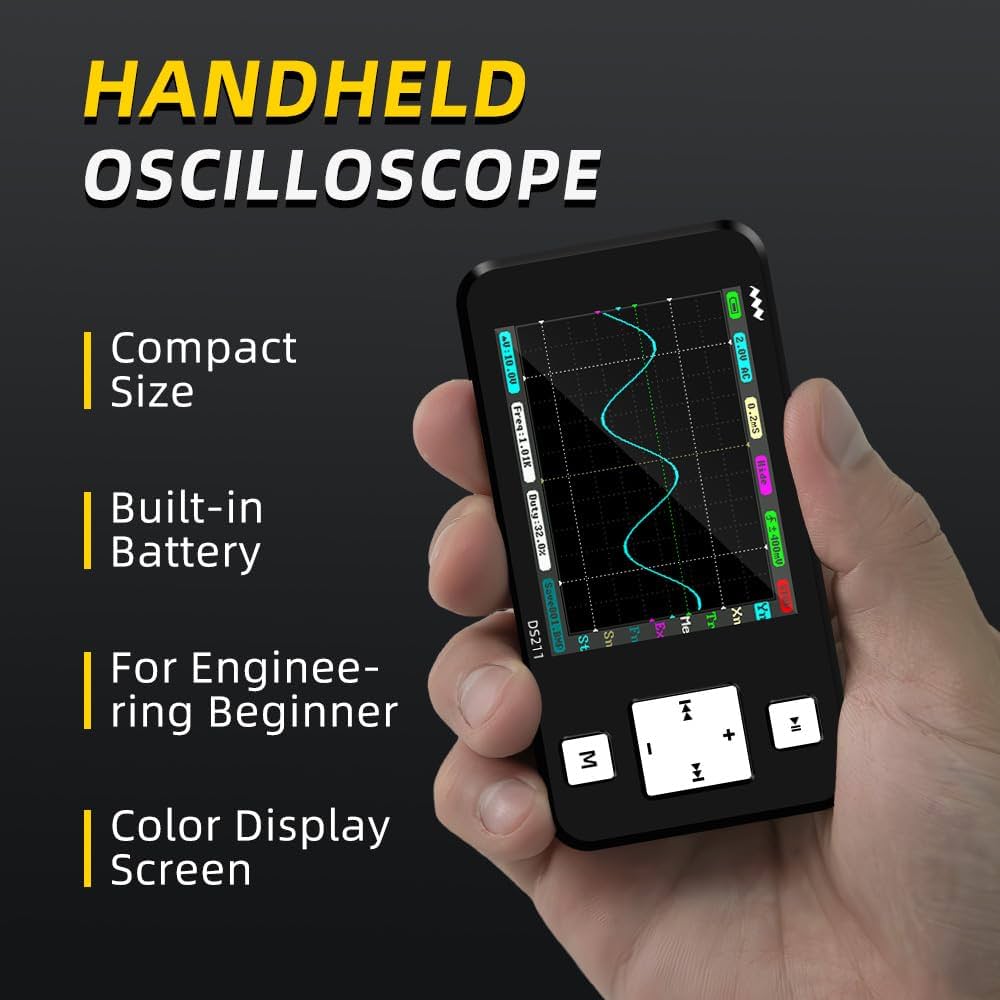
The DS211 is the smaller, significantly less capable sibling to the DS212 model. To achieve a lower price point, the manufacturer halved the channel count down to a single input, slashed the analog bandwidth to a meager 200 kHz, and dropped the maximum sample rate to just 1 MSa/s. Like its bigger brother, it remains highly portable, fully rechargeable via USB, and features the same minimalist, smartphone-esque aesthetic design. It retains 8 megabytes of internal storage for capturing basic screenshots and waveforms.
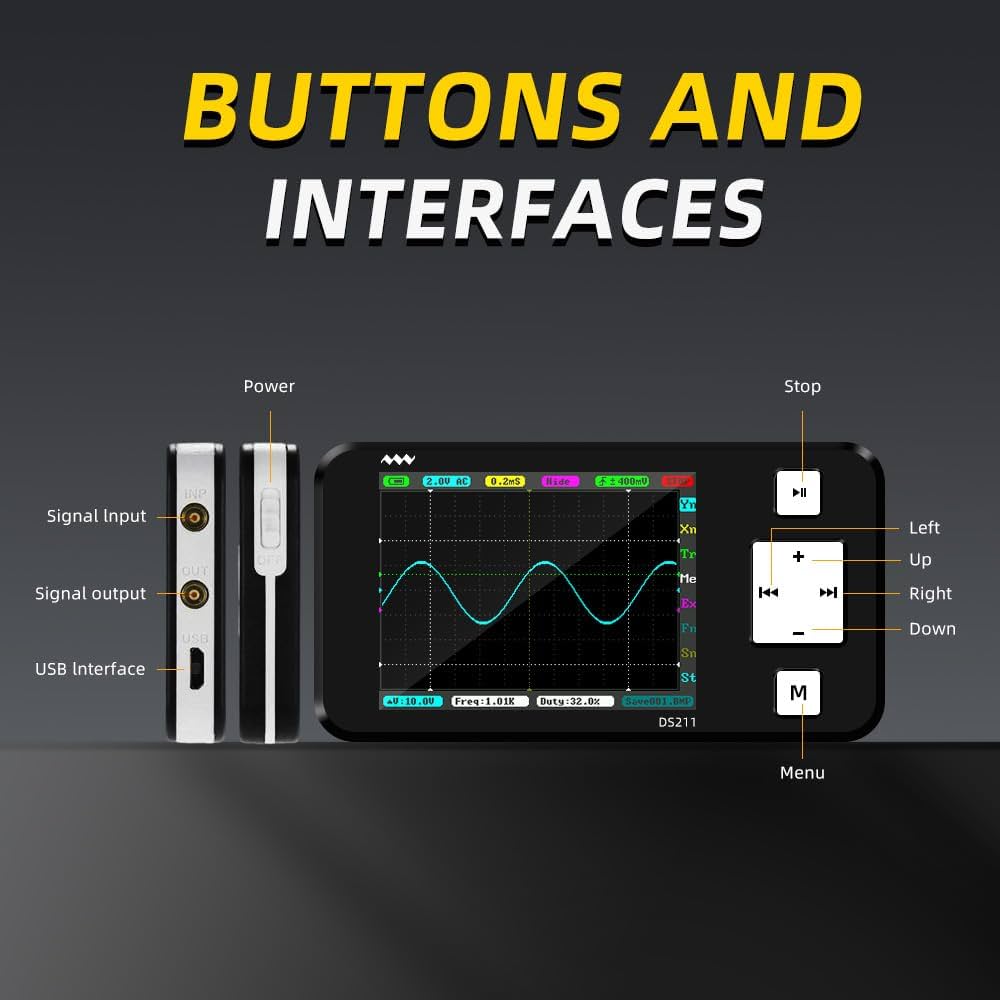
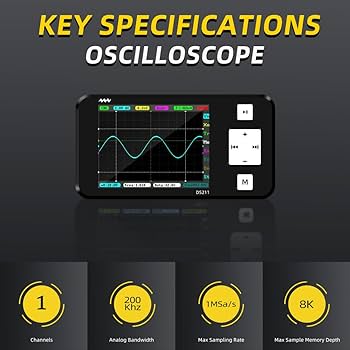
With an absolute maximum bandwidth ceiling of only 200 kHz, the DS211 is effectively blind to modern microcontroller clock speeds and high-speed digital communication busses. Its hardware limitations restrict it almost exclusively to measuring low-frequency audio waveforms, checking the slow output of basic operational amplifiers, or viewing physical-world mechanical sensor data (such as diagnosing a dirty automotive throttle position sensor or verifying a slow mechanical relay contact bounce).
DS211
Our Review
At an asking price of ₹7611, the DS211 represents exceptionally poor value for the modern maker or engineer. The crippling 200 kHz bandwidth is a severe hardware bottleneck that renders the device completely useless for diagnosing I2C, SPI, or high-frequency motor control PWM analysis. For anyone looking to debug an ESP32 or an Arduino system, this device will only display a useless, aliased blur of digital data.
It is ultimately an aesthetic novelty and a neat parlor trick rather than a serious piece of bench testing equipment.
Rank 7: FNIRSI DSO152 – The Absolute Bare-Minimum Audio Tool
FNIRSI has successfully flooded the global budget test equipment market with a massive variety of ultra-cheap, highly portable devices. The DSO152 represents the absolute bottom tier of their current operational product stack. It shares the exact same crippling 200 kHz analog bandwidth limitation as the more expensive DS211 but offers a marginally superior 2.5 MSa/s sample rate to slightly reduce digital aliasing on slow signals.
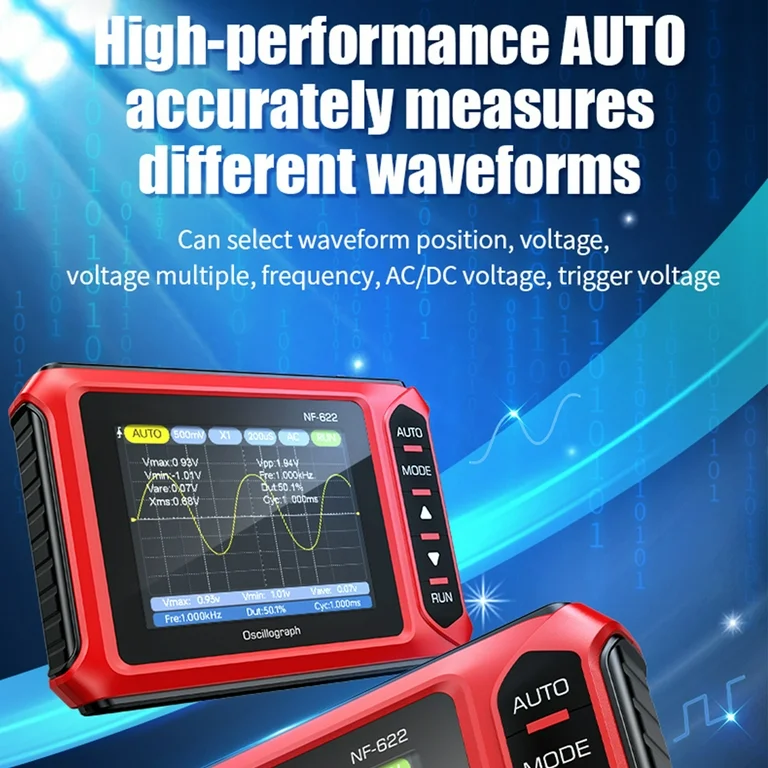
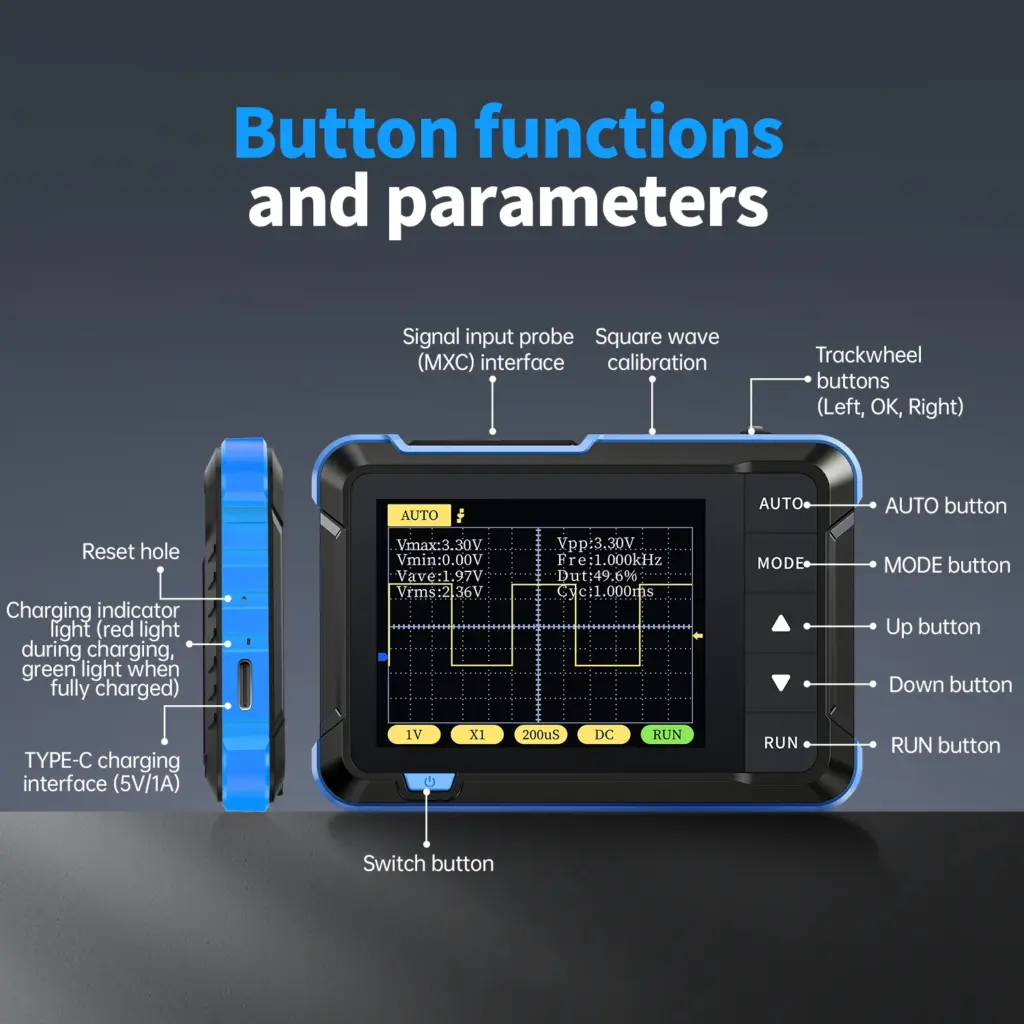
Priced aggressively at just under ₹3000, the DSO152 is essentially a standard digital multimeter equipped with a graphical display screen rather than a true oscilloscope. It features highly basic hardware triggering capabilities (Auto, Normal, Single sweep) and is rated to measure voltages up to ±400V safely, provided it is used in conjunction with a standard 10x attenuation probe. The physical interface is rudimentary but functional, utilizing a small color TFT screen and basic tactile push-button navigation.
Because the analog bandwidth is restricted to such a low limit, this device simply cannot physically capture the sharp rising edges of high-speed digital square waves. Any attempt to view logic-level communication from a microcontroller will result in a waveform that looks like a slow, rounded sine wave rather than a crisp, readable digital pulse.
FNIRSI DSO152
Our Review
A comprehensive FNIRSI review of this specific model yields a stark conclusion: the DSO152 is an educational toy, plain and simple. However, at a mere ₹2840, it is a highly affordable educational toy. It holds legitimate value strictly for absolute beginners who are learning the foundational basics of AC waveforms, or for amateur audiophiles testing basic clipping levels on DIY LM386 or TDA7297 audio amplifier circuits.
For any digital electronics work involving microcontrollers or switch-mode power supplies, this specific model should be entirely bypassed in favor of higher-bandwidth options.
Rank 6: FNIRSI DSO-153 – A Slight Bump in Megahertz
The FNIRSI DSO-153 is designed as a modest, incremental hardware upgrade over the baseline 152 model. The primary distinction is the internal amplification circuitry, which increases the analog bandwidth limit to 1 MHz and doubles the sample rate to 5 MSa/s. While 1 MHz remains vastly inadequate for high-speed digital protocol decoding or deep logic analysis, it does cross the critical threshold into being marginally useful for the absolute most basic, low-speed microcontroller tasks.
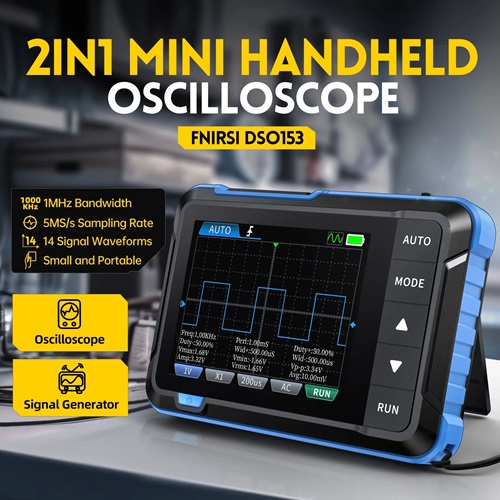
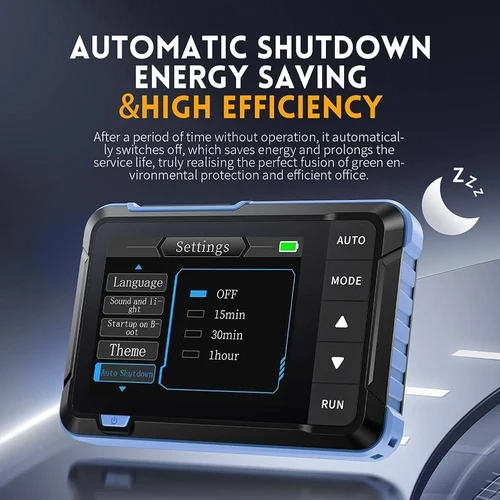
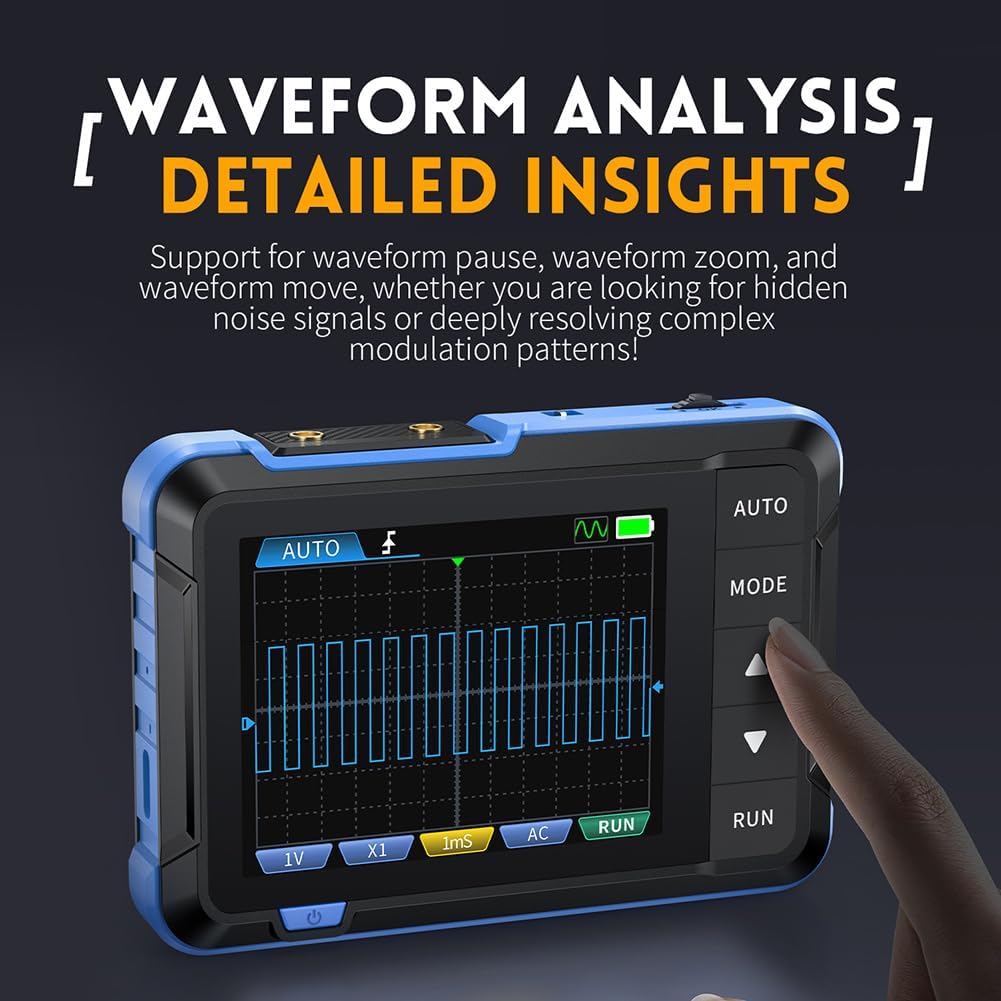
Operating at a 1 MHz bandwidth, an engineer can successfully visualize the default 490 Hz and 980 Hz PWM signals generated by an Arduino Uno’s standard analogWrite() functions. It is entirely capable of checking the slow, 50 Hz control pulse signals used to drive hobbyist servo motors, and it can be used to visually verify the physical presence (though not the high-speed data integrity) of low-speed serial UART data moving between sensors. The physical form factor remains highly compact and pocketable, running off an internal lithium battery. It features the same standard, user-friendly FNIRSI menu operating system that allows for quick, one-button “Auto” scaling, immediately adjusting the voltage scale and time base to roughly fit the detected waveform.
FNIRSI DSO-153
Our Review
For an additional investment of roughly ₹700 over the lesser DSO152, the DSO-153 provides a massive 500% mathematical increase in raw bandwidth capability. While it remains strictly classified as an educational teaching tool or a secondary, highly portable meter for basic slow-wave diagnostics, it is a vastly smarter purchase than the 152 for the severely budget-constrained electronics engineering student.
However, buyers must understand that it still falls far short of being a reliable, daily-driver tool for tracking down ESP32 I2C bugs or analyzing high-frequency power supply noise.
Rank 5: DSO138 – The Classic Maker Soldering Kit
The DSO138 holds a legendary status within the global DIY electronics and maker community. Unlike every other entry on this curated list, the DSO138 is not sold as a finished commercial product; it is frequently distributed as an unassembled educational kit comprising a bare printed circuit board (PCB), a 2.4-inch TFT screen, an ARM Cortex-M3 processor, and a bag containing dozens of through-hole resistors, capacitors, and tactile buttons.
Technologically speaking, its specifications are incredibly basic, featuring the same restrictive 200 kHz bandwidth and 1 MSa/s sampling rate found in the lowest-tier commercial devices. It utilizes a simple, standard BNC connector for probe attachment and provides essential software functions like rising and falling edge hardware triggers, as well as a dedicated “HOLD” function to instantly freeze the waveform display for visual analysis.
Because it is entirely barebones hardware – frequently lacking an acrylic or plastic protective case unless purchased as an additional accessory – the circuitry is highly susceptible to external electronic noise and RF interference if placed near a strong electromagnetic source like a running motor or a high-power transmitter.
DSO138
Our Review
The true value of the DSO138 does not reside in its performance as an analytical oscilloscope, but rather in its immense value as a masterclass in through-hole soldering and basic electronics hardware theory. At a remarkably low ₹1225, purchasing the kit is cheaper than attending a beginner electronics workshop. The physical act of building the DSO138 teaches the maker exactly how analog-to-digital converters physically interface with ARM microcontrollers, how SPI communication drives a TFT display, and how hardware interrupts function.
The end result is a working, self-built tool that can test audio signals and 555-timer circuits. It is highly recommended as an educational weekend project, but not as a primary diagnostic tool for a busy test bench.
Rank 4: FNIRSI DSO-510 – The Competent Pocket Scope
The FNIRSI DSO-510 represents the first highly significant leap into genuinely useful diagnostic territory for embedded engineers. With an analog bandwidth rating of 10 MHz and a rapidly digitizing sample rate of 48 MSa/s, this highly portable device is mathematically capable of capturing standard I2C data lines (which typically operate at 100 kHz or 400 kHz) and lower-speed SPI communication between microcontrollers and peripheral sensors.
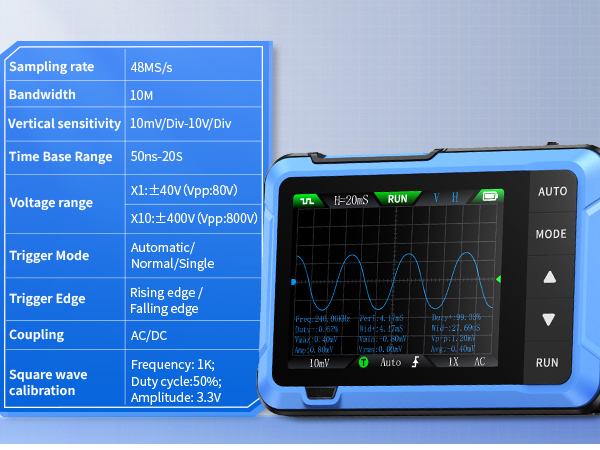

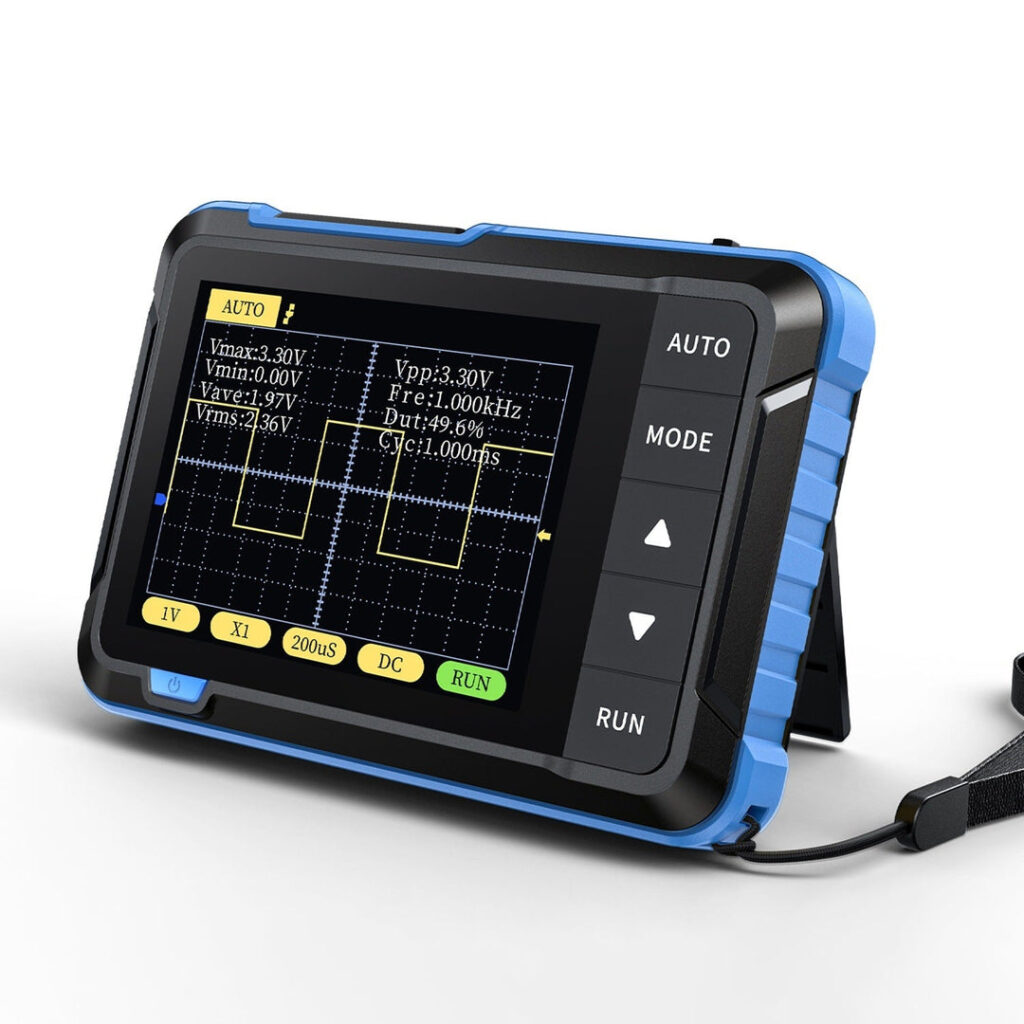
Weighing a mere 104 grams and housing an internal 1000mAh lithium battery that provides up to 4 hours of continuous operational use, the DSO-510 is designed for extreme portability without completely sacrificing speed. The hardware features a crisp 2.8-inch high-definition TFT LCD screen and a modern Type-C charging interface. The device is engineered to handle high transient voltages (safely reading up to ±400V when utilized with a standard 10x attenuation probe) and uniquely includes a built-in 50 kHz signal generator, making it highly versatile for rapidly testing audio amplifiers or simulating square-wave sensor inputs in the field. The user interface is heavily streamlined, featuring a highly efficient one-click AUTO mode that rapidly scales the voltage and time base to automatically fit the detected waveform without requiring complex manual dial adjustments.
FNIRSI DSO-510
Our Review
The DSO-510 is a brilliant piece of engineering for the price. At ₹3890, it finally provides enough raw bandwidth to actually see physical digital logic transitions, visually identify missing ACKs on an unstable I2C bus, and safely check the high-power gate drive signals on a solar charge controller.
While its architecture is strictly limited to a single channel—meaning the engineer cannot compare a clock signal against a data signal simultaneously for complex timing analysis—it is arguably the best portable “glovebox” oscilloscope for automotive repairs, field engineering, and quick physical diagnostics where deploying a full laptop setup is impossible.
Rank 3: FNIRSI DSO-TC4 – The Ultimate 3-in-1 Bench Companion
The FNIRSI DSO-TC4—the direct, upgraded successor to the highly popular DSO-TC3 model—is an ambitious hybrid device that attempts to successfully combine three distinct pieces of bench equipment into a single handheld chassis: a 10 MHz digital storage oscilloscope, an advanced component and transistor tester, and a dedicated function signal generator.
The oscilloscope section shares the exact same 10 MHz bandwidth and 48 MSa/s analog-to-digital architecture as the DSO-510, offering the same 400V maximum input protection and highly useful single-sweep triggering for capturing rapid, unpredictable physical switch bounces.
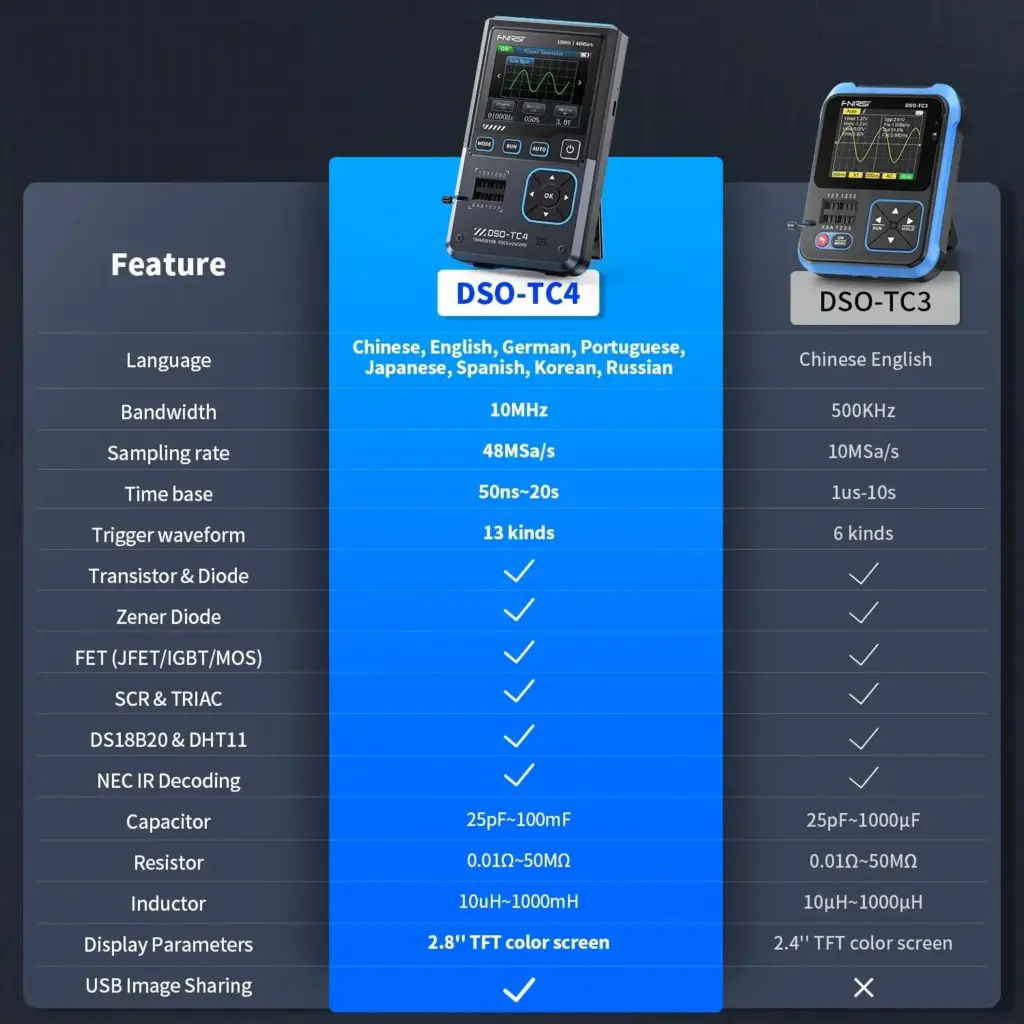
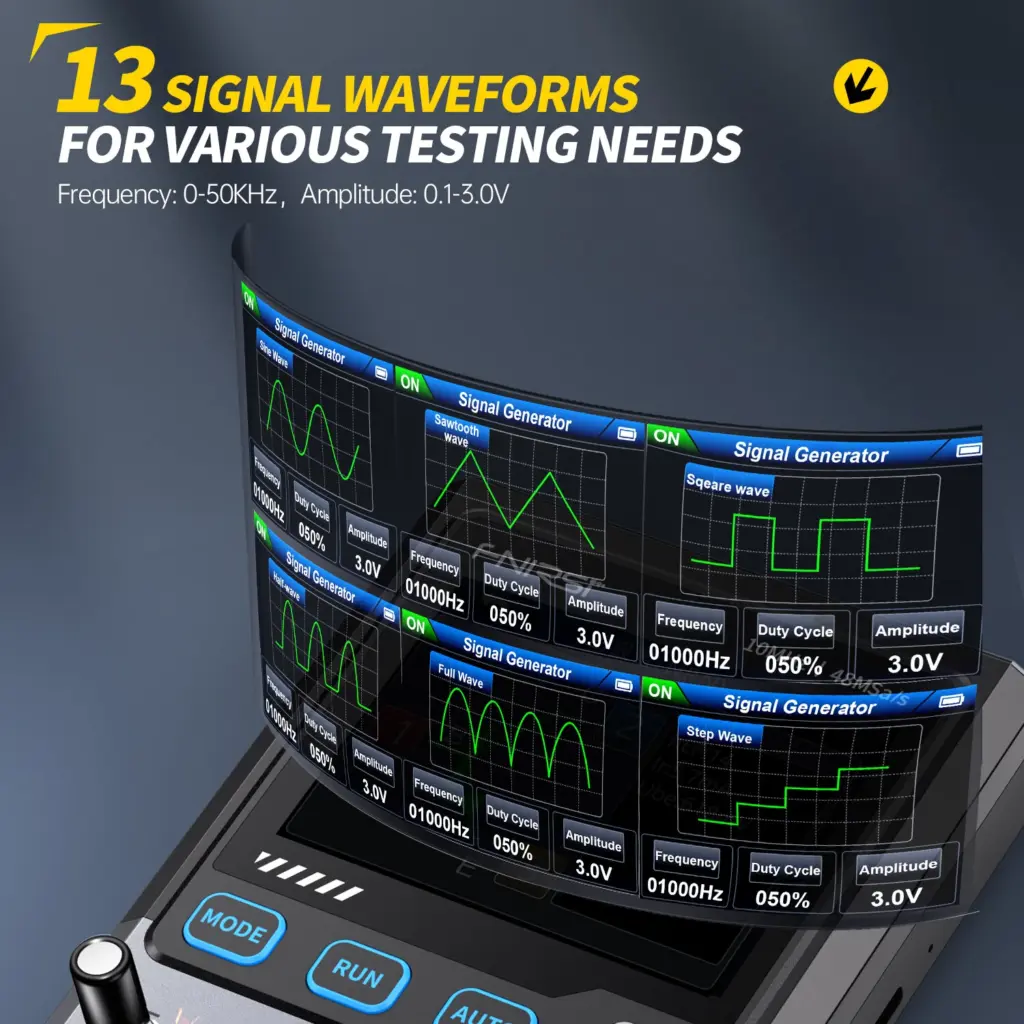
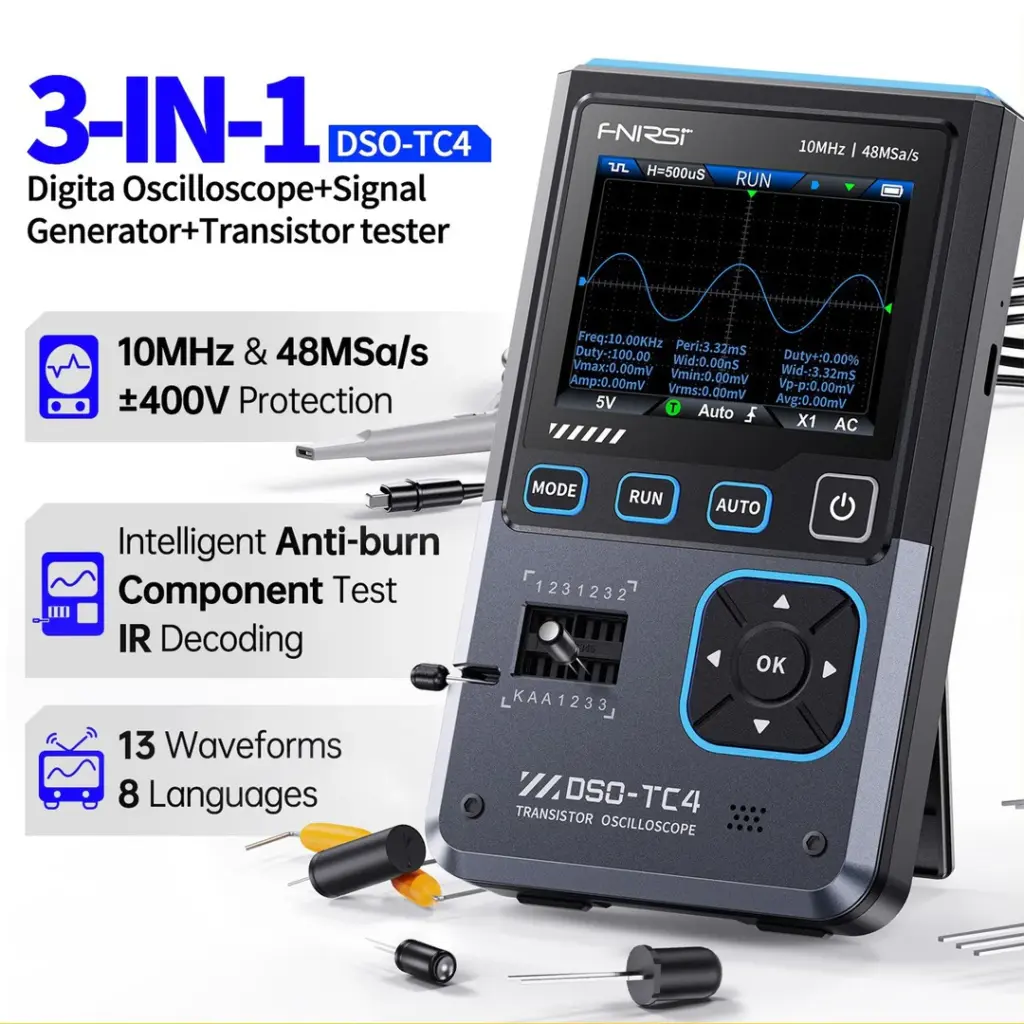
The absolute standout feature, however, is the integrated component testing ZIF (Zero Insertion Force) socket. The device allows the user to drop unknown, salvaged components (including resistors, electrolytic capacitors, inductors, diodes, power MOSFETs, and BJTs) directly into the socket. With a single button press, the device applies small test currents, measures the resulting voltage drops, identifies the specific component, maps out its exact pinout on the screen, and provides mathematical estimates of complex parameters like transistor forward voltage, parasitic capacitance, and Equivalent Series Resistance (ESR).
While the internal signal generator is highly competent, reaching output frequencies up to 100 kHz, power users have noted specific firmware quirks in the wild. For instance, the generator output strictly specifies Voltage Peak-to-Peak without providing explicit RMS units, and early firmware revisions locked the generator to a maximum of 1 kHz if the user attempted to operate the oscilloscope simultaneously. Furthermore, the internal ESR measurement algorithm for testing aging capacitors relies heavily on mathematical guessing rather than true, multi-frequency AC impedance testing.
FNIRSI DSO-TC4
Our Review
The DSO-TC4 operates flawlessly as the ultimate electronics Swiss Army Knife. While highly specialized repair technicians correctly point out that its ESR meter is mathematically unreliable for precision, board-level repair, its broad utility for general DIY electronics is entirely unmatched.
For ₹5739, the user acquires a tool that can instantly identify the pinout of a salvaged power MOSFET, generate a 10 kHz test tone, and visualize the output waveform of a custom audio amplifier. It is the absolute perfect all-in-one bench companion for makers dealing primarily in analog circuits, custom guitar pedals, and basic microcontroller interfacing where extreme precision is secondary to broad utility.
Rank 2: Hantek 6022BE – The Absolute King of Budget Logic Decoding
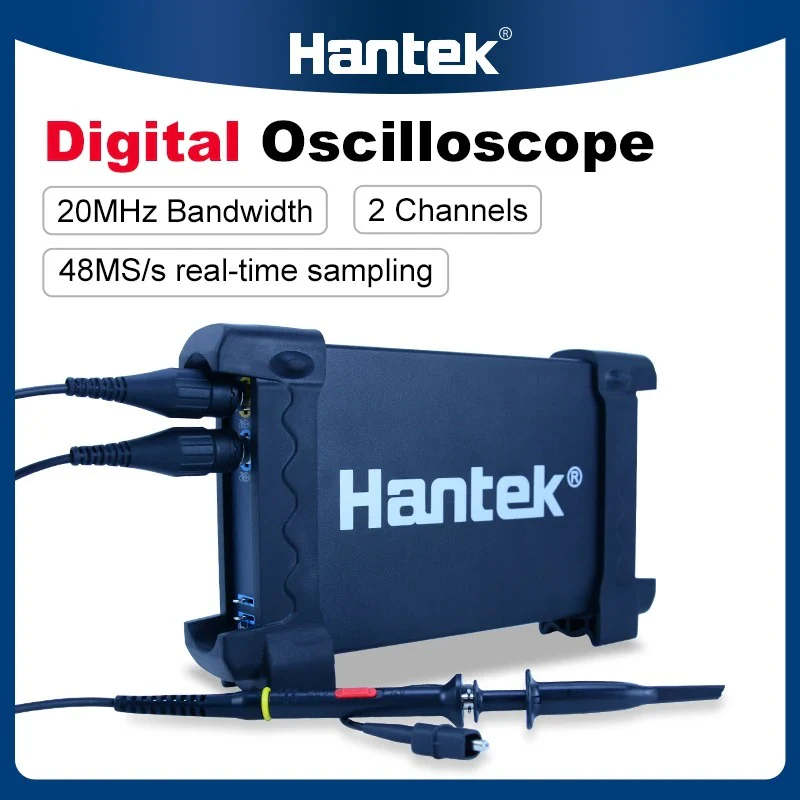
The Hantek 6022BE is an entirely different technological beast compared to the standalone FNIRSI lineup. It is a strictly PC-based USB oscilloscope featuring a highly rugged extruded aluminum case, thick rubberized end caps for drop protection, and dual analog channels mathematically capable of capturing a 20 MHz bandwidth with a 48 MSa/s sample rate. It has no internal screen, no internal battery, and no onboard firmware UI; it must be permanently tethered to a Windows or Linux PC via a standard USB 2.0 connection, which also provides its operating power.
Out of the box, the stock proprietary Hantek software provided on the included CD is notoriously clunky, unstable, and prone to crashing on modern operating systems. From a strict hardware perspective, the device suffers from a notably high noise floor – frequently displaying roughly 10mV of random internal noise even when operating on the sensitive 50mV scale. Furthermore, it entirely lacks physical hardware AC coupling relays. This omission means the user must physically build DIY external capacitors or rely on clunky software workarounds to strip DC voltage when attempting to measure high-frequency AC ripple on a standard DC power supply.
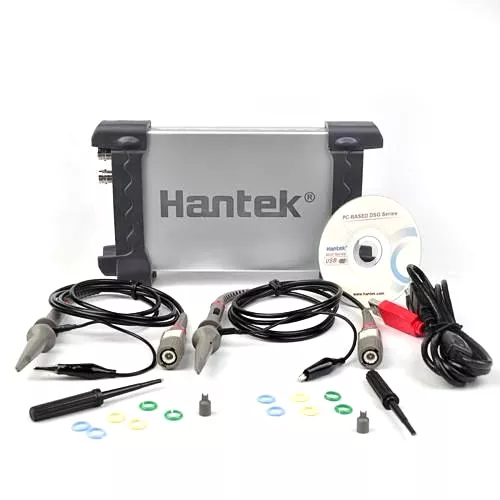
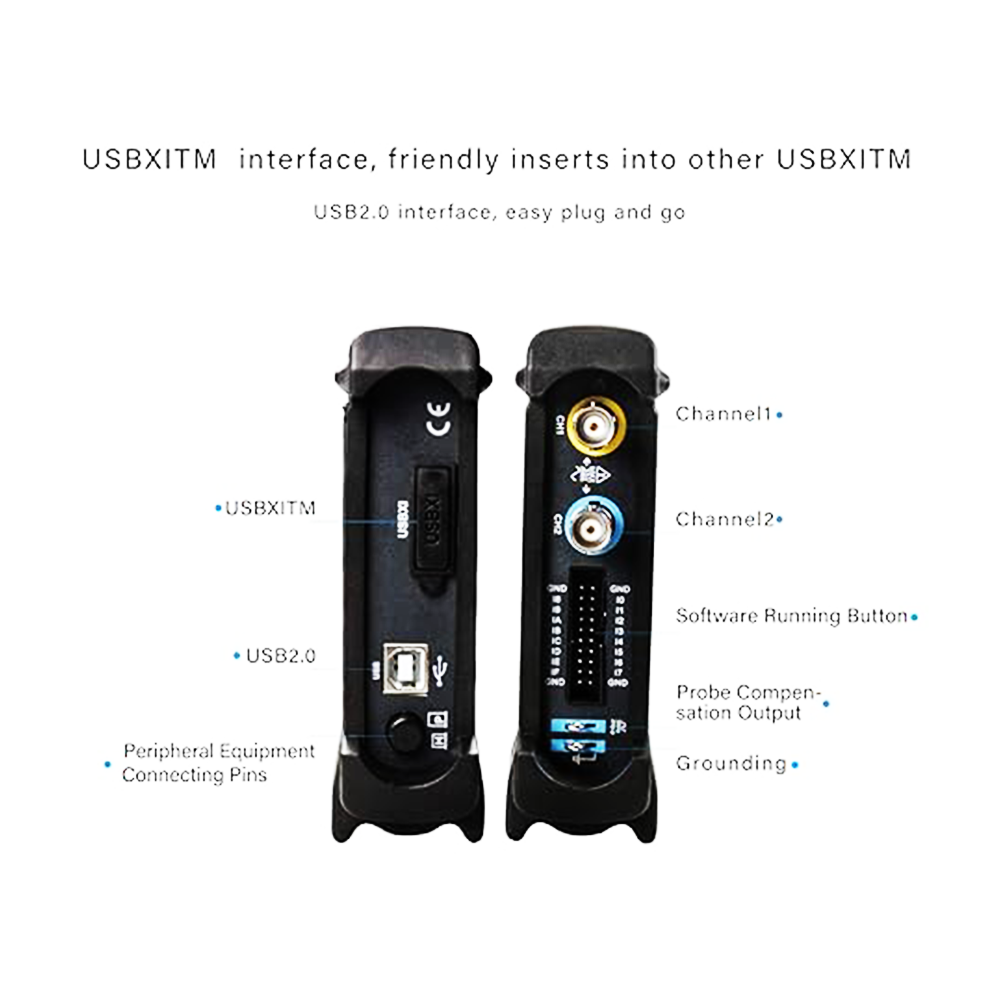
However, these physical hardware limitations are entirely overshadowed by the massive power of its open-source software ecosystem. The Hantek 6022BE is fully supported by the community-driven OpenHantek6022 project and, crucially, the Sigrok/PulseView initiative. PulseView is an immensely powerful, open-source, cross-platform signal analysis software package. Because the 6022BE continuously streams dual channels of raw ADC data directly to the PC’s memory, PulseView can utilize its vast, community-built library of protocol decoders to analyze the data stream in real time.
The workflow is revolutionary for budget debugging: the engineer can capture a complex, high-speed logic transaction across two pins and instantly apply a software decoder stack (converting analog voltages to digital logic levels, and then applying a specific protocol decoder) to automatically translate the raw waveform into human-readable I2C hex codes, SPI data bytes, or plain-text UART strings.
Hantek 6022BE
Our Review
A thorough Hantek 6022BE review reveals it to be the ultimate budget tool for the modern microcontroller software engineer. While it struggles slightly with clean analog power supply ripple measurement due to its inherently noisy front end and lack of AC coupling, it is an absolute analytical powerhouse for logic and protocol decoding.
Being able to run two channels simultaneously means the user can view an I2C Clock line (SCL) on Channel 1 and the corresponding I2C Data line (SDA) on Channel 2, allowing PulseView to mathematically decode the exact millisecond an ESP32 drops a data packet or experiences a timing violation. For ₹6836, if the project priority is fixing complex code and digital logic rather than pure, clean analog visualization, this device is the undisputed champion.
Rank 1: FNIRSI 2C53T – The Best Oscilloscopes in India Under ₹10K
Taking the undisputed top spot is the FNIRSI 2C53T, a standalone device that completely redefines the raw hardware capabilities currently available well under the 10K mark. Operating as a fully self-contained unit, it features dual high-speed analog channels, a fully integrated True RMS digital multimeter circuit, and a built-in arbitrary function generator.
The primary engineering reason this specific device commands the number one ranking is its staggering 50 MHz analog bandwidth paired with an incredibly fast 250 MSa/s sampling rate. Returning to the fundamental 5x rule of digital signal analysis, a true 50 MHz bandwidth allows the 2C53T to accurately visualize the sharp, high-frequency square-wave rising edges of 10 MHz digital signals without inducing significant analog distortion or harmonic filtering. The 250 MSa/s ADC is incredibly fast for this specific budget tier, guaranteeing that unpredictable transient voltage spikes, rapid switch-mode power supply parasitic ringing, and microsecond logic glitches are captured with incredibly high fidelity.
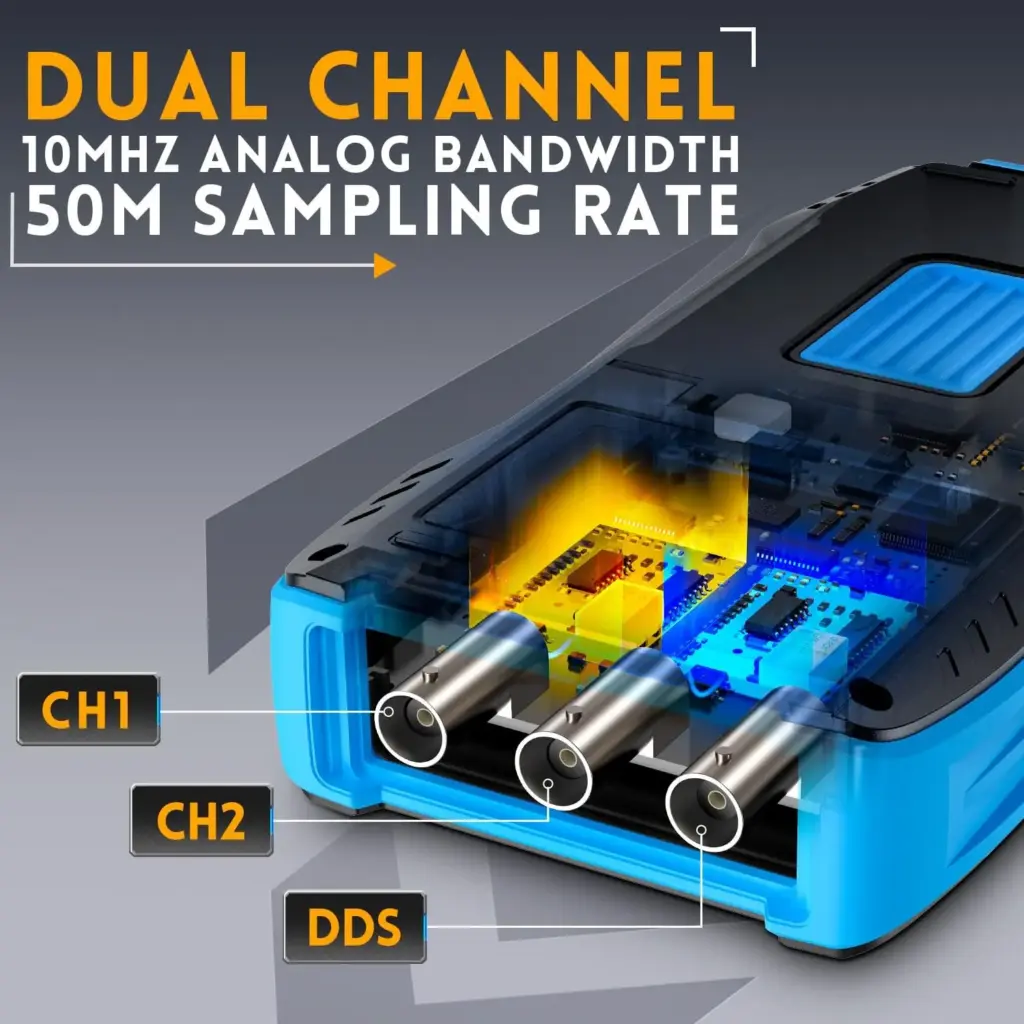

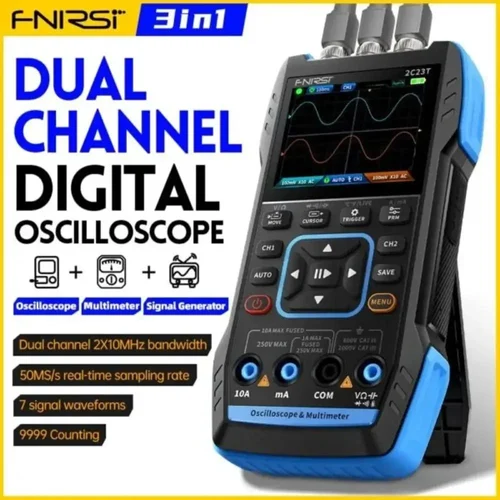
The device features a highly responsive, high-resolution touch-enabled interface combined with traditional physical tactile buttons, making navigation and rapid parameter scaling seamless. The integrated multimeter section is highly competent for standard resistance, DC voltage, and continuity testing, though precision engineers might still prefer an isolated, dedicated Fluke or UNI-T meter for critical, high-voltage mains measurements. The function generator has seen a slight frequency range reduction compared to older FNIRSI models, but it remains highly useful for injecting precise test signals into analog audio circuits or simulating basic sensor pulses.
It is highly critical to note that the device has exhibited some firmware quirks in the field. Updating the firmware strictly requires a Windows 10/11 environment, and early firmware revisions struggled heavily with rendering low-frequency pattern detection accurately, occasionally resulting in UI graphical glitches on the display when pushed outside expected operating parameters. Furthermore, as the input frequency is pushed toward the absolute 50 MHz hardware limit, users will observe an expected, physics-based drop in signal amplitude.
However, the manufacturer actively maintains the software ecosystem, regularly releasing firmware updates via their portal to address these specific software-side rendering issues. In our opinion, The FNIRSI 2C53T series are the Best Oscilloscopes in India Under ₹10K.
FNIRSI 2C53T
Our Review
The FNIRSI 2C53T stands as a major triumph of budget electrical engineering. For roughly ₹7550, it delivers a massive 250 MSa/s sampling rate and high-speed dual channels in a rugged form factor that can be effortlessly tossed into a backpack for field work. It completely and utterly invalidates the historical need for purchasing traditional, bulky, uncalibrated entry-level CRT scopes off the used market.
While it intrinsically lacks the PC-based deep logic decoding magic of the Hantek system, it is the absolute best standalone unit currently available for raw bandwidth, real-time hardware diagnostics, and measuring fast switching logic on an ESP32 or probing the gate of a high-power solar MOSFET. It provides unprecedented diagnostic capability for the Indian hardware hacker.
The Open-Source Ecosystem: Sigrok and PulseView
To fully appreciate the distinction between standalone devices and PC-based streaming oscilloscopes, one must understand the software that powers the latter. The budget oscilloscope market was fundamentally transformed by the open-source community, specifically through the development of the Sigrok and PulseView projects.
Sigrok is a cross-platform suite of software designed specifically to interface with various types of test and measurement equipment, including logic analyzers, oscilloscopes, and multimeters. PulseView acts as the primary graphical frontend for the underlying libsigrok and libsigrokdecode C libraries. When an engineer connects a compatible cheap digital storage oscilloscope—like the Hantek 6022BE—to their PC, PulseView bypasses the terrible proprietary software and takes direct control of the hardware’s USB streaming capabilities.
The true power of this ecosystem lies in its massive library of protocol decoders. If an engineer is monitoring a complex communication bus, visually interpreting the high and low voltage states of a waveform is nearly impossible. PulseView solves this through a process called decoder stacking. First, the software takes the raw analog voltage data streaming from the oscilloscope and applies an “analog-to-logic” threshold decoder, mathematically converting the varying voltages into perfect digital 1s and 0s. Next, the user stacks a specific protocol decoder—such as the I2C or SPI decoder—on top of that logic data. The software instantly analyzes the timing of the clock and data lines and outputs the exact hexadecimal values being transmitted by the hardware.
The open-source community continuously expands this library. Decoders exist for almost every conceivable embedded protocol, ranging from modern ARM debugging traces (ETMv3, TPIU) and JTAG, to legacy computing busses like the 6502 processor protocol, and highly specific display driver protocols. This level of deep logic analysis was previously restricted to logic analyzers costing thousands of dollars, making PC-based budget oscilloscopes an incredibly powerful investment for code-level debugging.
Conclusion: Best Oscilloscopes in India Under ₹10K
The sub-10K oscilloscope market in India has matured at an astonishing rate, offering sophisticated analytical tools that cover every possible requirement—from basic educational DIY assembly kits to highly sophisticated, high-bandwidth dual-channel diagnostic units.
For makers dealing exclusively in slow audio signals or students learning fundamental electronics theory, devices like the DSO138 and the 3-in-1 FNIRSI DSO-TC4 offer excellent, highly affordable entry points into signal visualization. However, for serious embedded systems engineering and precision hardware diagnostics, the choice ultimately branches into two distinct paths based entirely on the specific workflow requirements of the bench.
The Hantek 6022BE stands completely unrivaled as the best option for software developers, logic-focused tinkerers, and systems integrators who require the immense computational power of a desktop PC to mathematically decode complex I2C, SPI, and UART protocols utilizing the open-source PulseView software suite.
Conversely, for hardware engineers who absolutely require field portability, high-speed 250 MSa/s sampling rates, and the critical ability to capture rapid transient analog spikes on power supplies without booting up a laptop, the FNIRSI 2C53T provides an unbeatable 50 MHz of raw, dual-channel hardware power.